
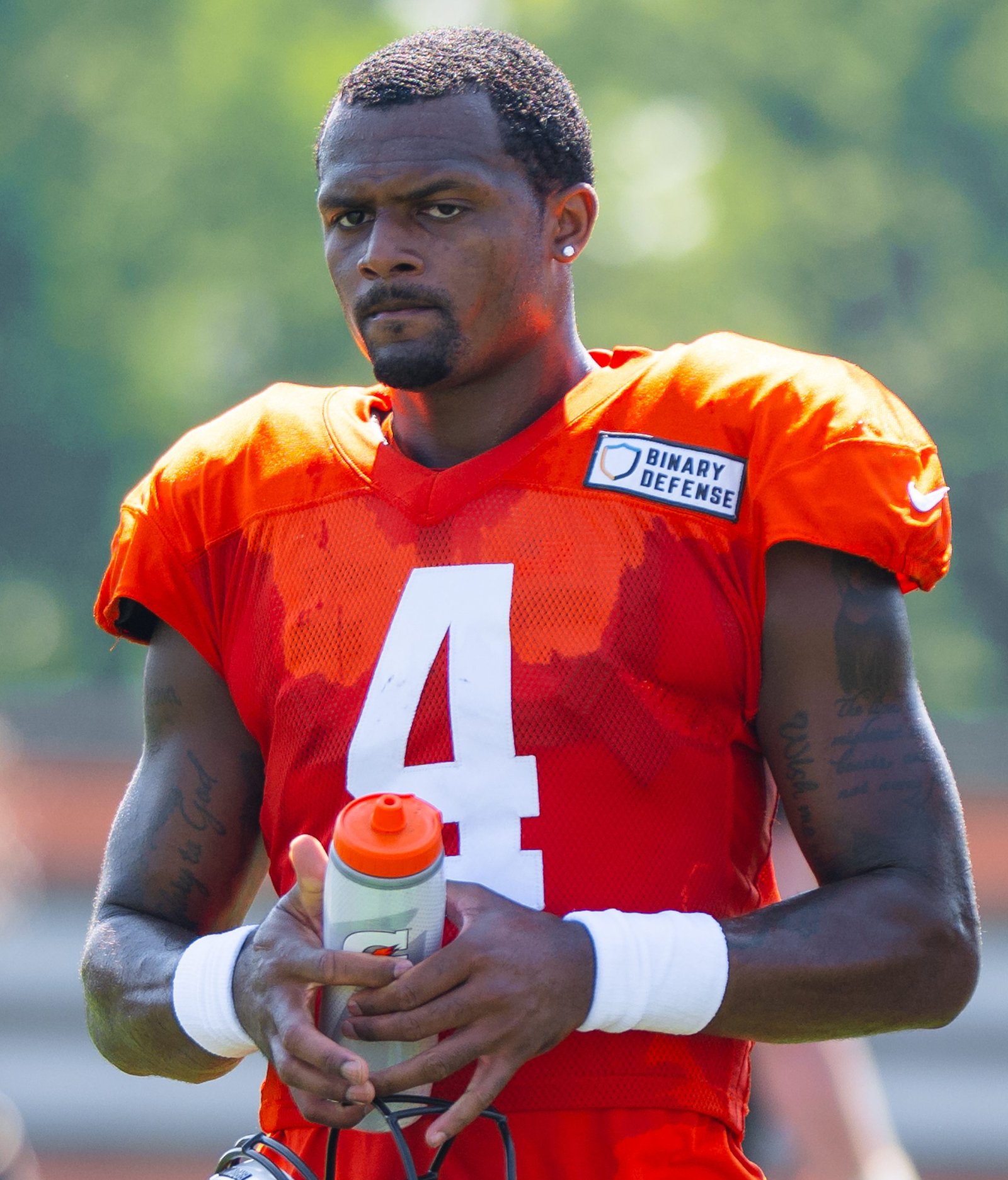
Deshaun Watson Career, NFL Journey, Stats, Contract and 2026 Comeback
Deshaun Watson has entered another important chapter of his NFL career. Once viewed as one of the league’s most dynamic young quarterbacks, Watson’s career has taken a complicated path through spectacular production, a lengthy absence, injuries, a major trade, a record-setting contract, and an uncertain tenure with the Cleveland Browns. Now, in the 2026 NFL season, he is back in the starting quarterback role and attempting to establish himself again on the field. The latest numbers show a player who has already contributed significantly to Cleveland’s early-season success, with Watson throwing for 855 yards, six touchdowns, and two interceptions through four games, according to the Browns and NFL statistical records.
What makes Watson’s story particularly interesting is the contrast between different stages of his career. During his time with the Houston Texans, he developed into a Pro Bowl quarterback and led the NFL in passing yards in 2020. After moving to Cleveland in 2022, however, he struggled to reproduce that level of performance while dealing with suspension and injuries. His Browns tenure was interrupted repeatedly, including by a shoulder injury in 2023 and an Achilles injury in 2024 that kept him out for the entire 2025 season.
The 2026 season therefore represents much more than another year on the schedule. It is an opportunity for Watson to demonstrate what kind of quarterback he can be after several difficult seasons. His first four games have included a rough opening loss to Jacksonville followed by three consecutive victories, and his Week 4 performance against Pittsburgh produced one of his most productive games in Cleveland. The Browns defeated the Steelers 27-24, with Watson completing 24 of 33 passes for 268 yards and a touchdown while leading a late drive that put Cleveland in position for a winning field goal.
Who Is Deshaun Watson?
Deshaun Watson is an NFL quarterback who currently plays for the Cleveland Browns. Born in Gainesville, Georgia, Watson developed into a highly regarded quarterback before entering the NFL after playing college football at Clemson. The Houston Texans selected him with the 12th overall pick in the 2017 NFL Draft, giving him an opportunity to become the centerpiece of their offense. He quickly showed why the organization invested a first-round selection in him, earning NFL All-Rookie recognition and developing into one of the league’s most productive dual-threat quarterbacks.
Watson’s game has historically been built around a combination of passing ability and athleticism. He has the arm strength to attack deep areas of the field, but he can also create plays when a pocket collapses. That combination became particularly dangerous during his Houston years because defenses could not simply treat him as a traditional pocket passer. If coverage prevented a quick throw, Watson could extend the play, move outside the pocket, or gain yards with his legs. That skill set helped him become a three-time Pro Bowl selection from 2018 through 2020.
His professional story has also included major controversy and substantial time away from football. More than 20 women accused Watson of sexual misconduct during massage sessions in 2021. Two Texas grand juries declined to pursue criminal charges, while the NFL later suspended Watson for the first 11 games of the 2022 season under its personal-conduct policy. These events became a major part of the public discussion surrounding his career and followed him into Cleveland.
Early Life and Football Background
Watson’s football development began long before he became an NFL quarterback. His athletic ability eventually took him to Clemson, where he became the face of one of college football’s most successful programs. Rather than arriving in the NFL as an unknown developmental quarterback, he entered the league with substantial national exposure and a reputation for making difficult throws while also threatening defenses with his running ability. His college experience also gave him significant exposure to high-pressure games, something that became useful once he reached the professional level.
The foundation of Watson’s style has remained recognizable throughout his career. He is most comfortable when he can operate from a clean pocket, but he has historically been capable of improvising when protection breaks down. That improvisational quality is one reason his best seasons in Houston produced so many explosive plays. At the same time, his later Cleveland seasons demonstrated how difficult it can be for any quarterback to maintain that style when injuries limit availability and disrupt rhythm. His career has therefore become a useful example of how quarterback success depends not only on talent, but also on health, continuity, coaching, protection, and opportunity.
Deshaun Watson at Clemson
Watson’s Clemson career established the platform for his professional success. Playing for head coach Dabo Swinney, he developed into a nationally recognized quarterback and helped Clemson reach the highest level of college football. His most memorable achievement came during the 2016 season, when Clemson defeated Alabama in the national championship game. Watson’s performance in that game became one of the defining moments of his college career because he delivered against an elite defense in a nationally watched contest.
At Clemson, Watson showed many of the characteristics that later appeared in Houston. He could make throws from the pocket, but he was also dangerous when moving outside the structure of the offense. That combination made him difficult for defenses to prepare for because a broken play did not necessarily mean the end of the down. Instead, Watson could turn a collapsing pocket into an opportunity for a run or a deep throw. His college production and physical tools ultimately helped make him a first-round selection in 2017.
The Texans selected Watson 12th overall, and his transition to the NFL was relatively quick. Although injuries limited him during his rookie season, he still produced enough to earn NFL Offensive Rookie of the Month honors and a place on the PFWA All-Rookie Team.
Entering the NFL With the Houston Texans
Watson’s arrival in Houston came at a time when the Texans were searching for long-term stability at quarterback. He was selected behind several other quarterbacks in the 2017 draft, but his talent quickly became apparent. In his rookie season, Watson played seven games and threw for 1,699 yards and 19 touchdowns, numbers that immediately generated excitement around his future. His season ended prematurely because of a torn ACL, but the early performance suggested that Houston had found a quarterback capable of changing the direction of the franchise.
The next phase of his career confirmed that promise. Watson became a regular starter and produced three consecutive Pro Bowl seasons from 2018 through 2020. His 2018 campaign included 4,165 passing yards and 26 touchdowns, while he followed that with 3,852 yards and 26 touchdowns in 2019. In 2020, his statistical production reached another level, as he completed 70.2% of his passes for 4,823 yards, 33 touchdowns, and only seven interceptions.
Those numbers explain why Watson became such a valuable quarterback before his departure from Houston. His ability to combine efficient passing with rushing production gave opposing defenses a difficult problem. He was not simply accumulating statistics in a high-volume passing system; he was creating first downs and explosive plays in multiple ways. By the end of the 2020 season, Watson had established himself as one of the NFL’s most productive quarterbacks.
Deshaun Watson’s Rise to NFL Stardom
The 2018 and 2019 seasons transformed Watson from an exciting young quarterback into a recognized NFL star. His ability to create outside the pocket was already evident, but his development as a passer made the overall package even more dangerous. He became increasingly comfortable reading defenses, identifying pressure, and taking advantage of opportunities downfield. His performance also helped Houston compete for playoff opportunities during those seasons.
One of Watson’s most notable traits was his ability to produce in difficult situations. The quarterback position often looks easiest when the offensive line provides a clean pocket and receivers create separation immediately. Watson’s value frequently became more obvious when those conditions disappeared. He could buy time, scramble, and keep a play alive long enough for a receiver to uncover. That ability helped him become the kind of quarterback who could change the outcome of a drive even when the original play had broken down.
His playoff performances added to his reputation. The Browns’ current biography notes that Watson recorded a 121.2 passer rating against Buffalo in the 2020 Wild Card round and later threw for 388 yards against Kansas City in the Divisional Round. Those performances helped reinforce the idea that Watson could perform on large stages.
The Record-Setting 2020 Season
Watson’s 2020 season remains the statistical high point of his NFL career. He led the league with 4,823 passing yards, while completing 70.2% of his attempts and throwing 33 touchdowns against seven interceptions. His passer rating was 112.4, and his average of 8.9 yards per attempt reflected the explosive nature of the Texans’ passing attack.
The achievement is important because it provides a clear benchmark for understanding Watson’s later career. When people discuss whether he can return to his previous form, 2020 is naturally the season that comes to mind. Yet comparing a quarterback in his early twenties with a quarterback returning after multiple injuries several years later is not as simple as comparing two statistical lines. Age, supporting cast, offensive scheme, injuries, and the number of snaps played can all dramatically change how a quarterback performs.
Watson himself has acknowledged that the goal is not simply to recreate the past. In an interview reported by NFL.com, he said he was not trying to “replicate the 2020” season and instead wanted to focus on being the best version of himself as a Cleveland player. That distinction matters because a successful comeback does not necessarily require reproducing every number from his Houston peak. It requires finding a sustainable way to operate effectively in his current circumstances.
Why Deshaun Watson Left Houston
Watson’s Houston career effectively ended after the 2020 season. He requested a trade after the season, and he did not play during the 2021 campaign. At the same time, allegations of sexual misconduct during massage sessions emerged and became a major legal and professional issue. Two Texas grand juries declined to pursue criminal charges, but the NFL subsequently suspended Watson for the first 11 games of the 2022 season.
The combination of the trade request, allegations, suspension, and prolonged absence created an unusually complicated situation for both Watson and the Texans. From a football perspective, Houston was moving away from a quarterback who had recently led the NFL in passing yards. From a league perspective, Watson’s return involved substantial scrutiny because his absence had lasted far longer than an ordinary injury recovery.
The Browns ultimately decided to acquire him in March 2022. Cleveland sent Houston a package that included three first-round picks along with additional selections. The move represented a major investment in a quarterback who had demonstrated elite production but had not played a regular-season game in more than a year. The Browns then paired the trade with a five-year, fully guaranteed contract worth $230 million.
The Cleveland Browns Trade
The Watson trade became one of the most consequential quarterback transactions in recent Browns history. Cleveland was not merely acquiring a player for one season; the organization was committing significant draft capital and financial resources to make Watson its long-term quarterback. The five-year, $230 million fully guaranteed contract was especially notable because guaranteed money at that scale was unusual for an NFL quarterback contract at the time.
From a football perspective, the reasoning was understandable: Cleveland believed Watson’s Houston production could translate into sustained success. From a roster-building perspective, however, the transaction carried substantial risk. Giving up multiple first-round selections reduced the team’s flexibility in future drafts, while the guaranteed contract meant the Browns had limited financial flexibility if Watson did not perform or became unavailable. Those risks became increasingly important as injuries limited his playing time.
Watson’s Cleveland contract has also been adjusted during his tenure. NFL Network reported in 2025 that Cleveland restructured the deal to create greater flexibility after the 2026 season, while Watson’s guaranteed money remained intact. The Browns also insured the contract, allowing the team to receive salary-cap relief associated with certain injury-related absences.
The Five-Year, $230 Million Contract
The contract remains central to any discussion of Watson’s Cleveland career. Entering the 2026 season, it was the final year of the original five-year agreement, and NFL.com reported a $40.9 million salary-cap hit for Cleveland in 2026.
The financial situation is complicated because the contract’s accounting extends beyond the years in which Watson actually receives a regular salary. Restructuring can move cap charges into future seasons, which means the end of a player’s playing contract does not necessarily mean the end of his financial impact on a team’s salary cap. Reports during 2026 have also examined insurance-related credits and how they affect Cleveland’s future cap position.
For Watson, the contract is significant because it represents the expectations attached to his Cleveland arrival. For the Browns, it represents a long-term roster decision that must be managed alongside the team’s current roster. The financial story is therefore separate from the football story, even though the two are closely connected.
Deshaun Watson’s Browns Career
Watson’s Browns career began in 2022 after his suspension ended. He played six games that season, completing 99 of 170 passes for 1,102 yards, seven touchdowns, and five interceptions. His passer rating was 79.1.
In 2023, Watson again played only six games. He passed for 1,115 yards, seven touchdowns, and four interceptions while posting an 84.3 passer rating. The season included one of the more memorable flashes of his Cleveland tenure when he helped the Browns rally against Baltimore, but a shoulder injury eventually ended his season.
The 2024 season was similarly interrupted. Watson played seven games and threw for 1,148 yards and five touchdowns before suffering an Achilles injury against Cincinnati. The injury required multiple surgeries and ultimately kept him out for the entire 2025 season.
That history explains why his 2026 return is so significant. Before the 2026 season, Watson had played only 19 games for Cleveland across several seasons. His availability had become almost as important a question as his performance.
Injuries, Suspension and Missed Time
Availability has been one of the defining themes of Watson’s career since he left Houston. His early NFL career was also interrupted by injury, including the ACL injury that ended his rookie season. Later, his Cleveland tenure was affected by suspension, a throwing-shoulder injury, and the Achilles injury that removed him from football for the entire 2025 season.
The shoulder injury was particularly important because it ended Watson’s 2023 season after only six appearances. The Achilles injury followed in 2024 and required an extended rehabilitation period. NFL.com reported that Watson had been recovering from the Achilles injury and eventually returned to football activities before the 2026 season.
Long layoffs can affect quarterbacks in ways that do not always appear immediately in a box score. Timing with receivers can take time to rebuild, pocket movement can change, and a quarterback may need to adjust how aggressively he runs or extends plays. Watson’s 2026 campaign therefore represents a test of both physical recovery and football rhythm.
Deshaun Watson’s 2026 Return
Watson entered the 2026 offseason competing for the Browns’ starting job. Cleveland had another young quarterback option in Shedeur Sanders, creating an unusual situation in which a highly paid veteran was competing for his position rather than simply receiving it automatically. Head coach Todd Monken ultimately selected Watson to start Week 1 against Jacksonville.
The decision was based on the coaching staff’s assessment of the offseason, training camp, joint practices, and preseason work. Monken said the staff believed Watson gave Cleveland its best opportunity to move the ball and score points in the season opener.
The opening game did not go Cleveland’s way, as the Browns lost 34-10 to Jacksonville. Watson completed 16 of 22 passes for 205 yards, one touchdown, and one interception. But the season changed quickly afterward. Cleveland won its next three games, and Watson became increasingly important to those victories.
Winning the Starting Quarterback Job
Watson’s role became more secure as the season progressed. Against Tampa Bay in Week 2, he completed 24 of 30 passes for 238 yards and two touchdowns without an interception, producing a 121.9 passer rating. Against Carolina the following week, he threw two touchdown passes in a 21-18 comeback victory.
Then came the Steelers game. Watson completed 24 of 33 passes for 268 yards, one touchdown, and one interception in Cleveland’s 27-24 victory. The Browns moved to 3-1, their best four-game start since 2021, while Watson led another late drive that positioned kicker Andre Szmyt for the winning 56-yard field goal.
That does not erase the questions surrounding Watson, but it does show that his 2026 return is producing meaningful on-field results. Through four games, the Browns’ official profile lists Watson with 855 passing yards, six touchdowns, two interceptions, and a 101.18 passer rating.
Deshaun Watson 2026 Stats
Watson’s first four games of 2026 provide a useful snapshot of his current performance:
| Statistic | 2026 through Week 4 |
|---|---|
| Games | 4 |
| Completions | 80 |
| Attempts | 115 |
| Completion percentage | 69.6% |
| Passing yards | 855 |
| Yards per attempt | 7.4 |
| Passing touchdowns | 6 |
| Interceptions | 2 |
| Passer rating | 101.2 |
| Rushing attempts | 31 |
| Rushing yards | 127 |
These figures come from NFL statistical records through the Browns’ Week 4 victory over Pittsburgh.
The numbers also show a notable change from Watson’s earlier Cleveland seasons. His 2022, 2023, and 2024 passer ratings were 79.1, 84.3, and 79.0 respectively, while his first four games of 2026 produced a 101.2 rating.
Of course, four games are a small sample compared with an entire NFL season. The larger question is whether Watson can maintain his efficiency while remaining healthy and handling the pressure that comes with being Cleveland’s starting quarterback. His current statistical line provides evidence of a productive start, but it does not by itself determine how the rest of the season will unfold.
Watson’s Week 4 Performance Against Pittsburgh
The Steelers game was arguably Watson’s most complete performance of the young 2026 season. He completed 24 of 33 passes for 268 yards and a touchdown, and he helped Cleveland repeatedly respond when Pittsburgh threatened to take control. The Browns ultimately won 27-24 on Szmyt’s 56-yard field goal with 10 seconds remaining.
Watson’s contribution went beyond his passing totals. With Cleveland needing another scoring opportunity late, he completed key passes to KC Concepcion Jr., Jerry Jeudy, and Harold Fannin Jr. to move the offense 36 net yards into field-goal range. The Browns’ official game breakdown credited Watson with helping create the winning opportunity after Pittsburgh had erased an 11-point deficit.
The game also highlighted the importance of Cleveland’s supporting cast. Denzel Boston produced 89 receiving yards, Fannin scored a touchdown, and the Browns’ defense intercepted Aaron Rodgers twice while recording five sacks. In other words, Watson did not win the game by himself. He operated as part of an offense and team that found ways to produce in important moments.
Playing Style and Strengths
Watson’s traditional strengths remain centered on arm talent, mobility, and play extension. At his best, he can throw accurately from different platforms, attack downfield, and use his legs when defenders create pressure. His career numbers show that dual-threat ability has always been part of his game, with his rushing production complementing his passing statistics.
His mobility can be especially valuable against aggressive defenses. When pass rushers collapse the pocket, a quarterback who can escape creates a second layer of difficulty. Instead of simply forcing a throw or taking a sack, Watson can move laterally, buy time, and potentially turn a broken play into a positive gain. That trait helped define his Houston peak and has remained visible during his 2026 return.
Another strength is experience. Watson has played in major college games, NFL playoff games, and regular-season environments where every possession carries significant pressure. The challenge now is combining that experience with the physical demands of a modern NFL season. His early 2026 numbers suggest that the quarterback can still operate efficiently, but sustaining that level over a full season will be the larger test.
Arm Talent and Mobility
The combination of throwing ability and movement makes Watson different from a purely pocket-based quarterback. His 2020 statistics illustrate how effectively he once used that combination, while his 2026 rushing totals show that mobility remains part of his game. Through four games, he had 127 rushing yards on 31 attempts, according to NFL statistics.
Still, mobility must be managed carefully after a long injury history. Quarterbacks returning from major lower-body injuries sometimes have to balance the natural instinct to escape with the need to protect themselves. Watson does not need to become a completely different player, but finding efficient ways to move without taking unnecessary punishment can be an important part of maintaining availability.
Career Statistics and Achievements
Watson’s career numbers demonstrate why expectations around him have remained high. Through four games of the 2026 season, he had accumulated 18,759 passing yards, 129 touchdown passes, and 50 interceptions over 77 regular-season games. His career completion percentage stood at 66.4%, with a 98.9 passer rating.
His Houston peak remains particularly impressive. In 2020, Watson threw for 4,823 yards and 33 touchdowns, led the NFL in passing yards, and posted a 112.4 passer rating. He also earned three consecutive Pro Bowl selections from 2018 through 2020.
His career also contains several unusual statistical achievements. The Browns’ official biography notes that Watson became the first player in NFL history to record consecutive seasons with at least 25 passing touchdowns and five rushing touchdowns in 2018 and 2019. It also notes that he was the first player to surpass 10,000 passing yards and 1,000 rushing yards during his first 40 games.
Those achievements remain part of the larger story because they establish the level of quarterback Watson was before the interruptions that followed.
Contract Situation and Cleveland’s Future
The 2026 season is especially important from a contract perspective because Watson entered the final year of his original Cleveland agreement. The five-year, $230 million contract was fully guaranteed, and Cleveland has spent several seasons managing the financial consequences of that commitment. NFL.com reported that Watson’s 2026 cap hit was approximately $40.9 million.
The Browns also restructured the contract in 2025 without reducing Watson’s guaranteed money. That move was designed to give the organization greater flexibility after the contract’s scheduled expiration while preserving its existing financial commitments. Insurance related to Watson’s injury absences has also become part of the financial picture.
What happens beyond 2026 depends on several factors, including Watson’s health, performance, the Browns’ quarterback plans, and the team’s financial calculations. Cleveland has already invested significant resources in the position, but NFL teams constantly reassess quarterback situations as contracts, draft picks, performance, and roster needs change. The 2026 season therefore provides important information for both Watson and the organization.
What Comes Next for Deshaun Watson
The immediate challenge for Watson is straightforward: continue playing and remain healthy. His first four games have already shown both sides of the current story. The opening loss to Jacksonville demonstrated that the Browns still have issues to solve, while three straight victories against Tampa Bay, Carolina, and Pittsburgh showed that the team can win with Watson leading the offense.
The next stage will test whether the offense can remain efficient as opponents adjust. NFL seasons are long, and defensive coordinators eventually develop plans designed specifically around a quarterback’s tendencies. Watson’s ability to make adjustments, protect the football, and create explosive plays will become increasingly important as the schedule becomes more difficult.
There is also the question of his long-term future. Watson’s original Cleveland contract ends after the 2026 season, although contract accounting can extend beyond the playing term. The organization has not closed every possible door, and Browns general manager Andrew Berry has previously declined to completely rule out another Watson deal. The most meaningful evidence, however, will continue to come from what Watson does on the field.
Deshaun Watson’s NFL Legacy
Watson’s legacy is unusually complex because it contains both elite statistical production and a highly controversial second half. His Houston years established him as a Pro Bowl quarterback capable of leading the NFL in passing yards. His Cleveland years have been defined by suspension, injuries, limited availability, and the enormous expectations attached to his contract. The 2026 season has added another chapter by giving him an opportunity to start again and produce meaningful wins.
From a purely statistical perspective, his Houston peak is difficult to overlook. A 4,823-yard passing season with 33 touchdowns and seven interceptions is elite production, and his three Pro Bowl selections demonstrate how highly he was regarded during that period.
At the same time, evaluating his entire career requires acknowledging the off-field allegations and the NFL suspension that followed. Those events are part of the public record and have influenced how Watson’s career is discussed. The football portion of his story cannot be separated entirely from the broader circumstances surrounding his time away from the league.
In 2026, Watson has the opportunity to add a different kind of chapter. He does not need to erase the past for the season to be meaningful from a football perspective. Instead, the focus is on whether he can remain available, operate effectively within Cleveland’s offense, and demonstrate that he can still be a productive NFL starting quarterback.
Conclusion
Deshaun Watson remains one of the NFL’s most closely watched quarterbacks because his career has included an extraordinary combination of success, controversy, injuries, and financial commitment. His Houston years showed what his physical talent could produce, particularly during the 2020 season when he led the league with 4,823 passing yards. His transition to Cleveland produced a much different story, with suspension and injuries limiting him to only 19 games before the 2026 season.
The current season has changed the conversation again. Watson opened 2026 as Cleveland’s starting quarterback and, through four games, has thrown for 855 yards, six touchdowns, and two interceptions while helping the Browns reach a 3-1 record. His Week 4 performance against Pittsburgh was particularly significant, as he threw for 268 yards and a touchdown before leading the late drive that set up Cleveland’s winning field goal.
Whether this becomes a full-season resurgence or simply a strong stretch will depend on what happens next. For now, the numbers show a quarterback who has returned to meaningful NFL action and is contributing to a winning Cleveland team. After years of interruptions, Watson finally has the opportunity to let his performance on the field define the next stage of his football career.
Frequently Asked Questions About Deshaun Watson
1. Who does Deshaun Watson play for?
Deshaun Watson currently plays quarterback for the Cleveland Browns. Cleveland acquired him from the Houston Texans in March 2022 and signed him to a five-year, $230 million fully guaranteed contract. The Browns selected him as their starting quarterback for Week 1 of the 2026 season, and he remained the starter through Week 4.
2. What are Deshaun Watson’s 2026 statistics?
Through the first four games of the 2026 regular season, Watson had completed 80 of 115 passes for 855 yards, six touchdowns, and two interceptions. His completion percentage was 69.6%, and his passer rating was 101.2. He also had 127 rushing yards on 31 attempts.
3. How many Pro Bowls has Deshaun Watson made?
Watson has been selected to the Pro Bowl three times, earning the honor in 2018, 2019, and 2020 while playing for the Houston Texans. His 2020 season was particularly productive because he led the NFL in passing yards with 4,823.
4. What happened to Deshaun Watson’s contract?
Watson signed a five-year, $230 million fully guaranteed contract with Cleveland after being traded from Houston. The Browns later restructured the agreement in 2025 to create additional future financial flexibility without reducing his guaranteed money. His original playing contract is scheduled to expire after the 2026 season, although related salary-cap charges can extend beyond the playing term.
5. What was Deshaun Watson’s best NFL season?
Statistically, Watson’s 2020 season with the Houston Texans stands out as his best regular-season campaign. He led the NFL with 4,823 passing yards, threw 33 touchdown passes against seven interceptions, completed 70.2% of his passes, and posted a 112.4 passer rating.
Also Read : ken-urker-biography
[…] Also Read :Deshaun Watson […]
[…] Also Read :Deshaun Watson […]